

Welcome back to the blog! It has been a while since I have written a formal post. A lot has been going on in my life and in the world that has made the writing of music posts seem a little trivial and unimportant. However, as the emotional fog of my own life has begun to lift, I am reinvigorated with my belief in the importance of the Arts and, specifically, of the gift of the creative process. Therefore, I write again.
At this moment in time, the Western World, as we once knew it, is under siege and has begun to transform itself into something almost unrecognizable. People who lived in the former “Land of the Free” are literally fighting for their very lives in the streets and neighbourhoods of the places that they call home. It would all be even more shocking if not for the fact that, as students of history, we have seen this transformation unfold with devastating consequences before. No one who has even a passing familiarity with authoritarianism (such as the rise of the Nazis in Germany in WWII) should be surprised at the state that the world has become. The times are indeed grim. But in the darkest of times, collective action and firm resolve have often been the tonic necessary to reverse bad fortunes. As we know, there are some things that are worth fighting for. Among the most basic of those things is the right to carve your own path in life and live as you so choose without fear or shame. This brings us to the subject of today’s post.
The animated movie KPop Demon Hunters may, at first blush, seem like a child’s cartoon adventure (which it partially is) but it is actually a more substantive movie than that. I have to be honest and tell you that I enjoyed the film more than I was expecting. In many ways, the reaction I had to watching KPop Demon Hunters for the first time was the same as the one I had a decade or so ago when I took my daughter to the local theatre to watch Frozen. In both cases, I thought that the storylines were more involved and mature than I had experienced with other “kid’s movies”. I also immediately recognized the cultural and financial importance of music to both films. Believe me when I tell you that the songs contained in the KPop Demon Hunters soundtrack will, in time, become as familiar and popular and award winning as “Let It Go” was for Frozen. In fact, today’s featured song, “Golden” has already won the award as Best Original Song in the Golden Globe Awards, the Critic’s Choice Awards and almost every other award for which it has been nominated. “Golden” will win the Academy Award for Best Original Song in a few weeks, as well. I guarantee it. So what is it about the movie KPop Demon Hunters that makes it so well-received and popular with fans and critics alike? And why are the songs contained in the soundtrack destined to become such huge international hits? The answer to that can be found in topics as broad as geopolitics and as personal as our own identities and our desire to be accepted and fit in. So get ready for a trip around the world and into your heart. Here is the story of a little movie that is set to become a box office movie franchise to rival that of existing behemoths such as Harry Potter, Star Wars, the Marvel Universe and the world’s most successful entertainment franchise, Pokemon. Today’s journey starts quite simply with the title. Let us begin.
In order to understand and appreciate KPop Demon Hunters fully, it is important to know that it was designed partially as a showcase to South Korean culture. Like many countries around the world, South Korea has its own history, customs and cultural symbols that hold much meaning to the generations of citizens who lived their lives there. Prior to the invention of the television and, subsequently, the internet, South Korea existed quietly in its own corner of the world. Any external cultural or political influences it felt came from other Asiatic countries such as China, Japan, Vietnam and so on. In this relatively localized sphere of influence, South Korea developed an Arts scene that was unique unto itself, often reflecting the history and mythology of its people and the surrounding area. Fast forward to the Korean War. During the 1950s, South Korea found itself in the centre of a regional war. Many foreign armies became involved and soon the country found itself playing host to military bases housing thousands of international soldiers from America, Canada, England and so on. In time, South Korean performers began playing music for these soldiers at their bases. Their brand of harmony-filled Pop music was welcomed by the weary soldiers. So much so that when the Korean War came to an end, several of these musical acts were invited to come to North America to perform on the emerging medium of network television, specifically on shows such as The Ed Sullivan Show. Upon returning to South Korea, these performers were regarded with much national pride as being akin to heroes. A positive cycle of pride ensued which caused the creation of a formal, permanent entertainment training infrastructure within South Korea that eventually became known as KPop. In the many decades that followed, the success of KPop bands grew. When the internet became widespread, KPop found a way to amplify their sound and soon boy bands such as BTS and girl groups like Blackpink became among the leaders in digital streaming in the world. So, the first thing to know about the Netflix movie KPop Demon Hunters is that the main characters belong to a girl band called Huntrix and a boy band called Saja Boys and that the movie is basically a musical, with songs being used to tell a majority of the story. Music is very important to South Korea’s national identity and, not surprisingly, it is very important to the structure of KPop Demon Hunters, too.

A second aspect of South Korean culture that forms an integral portion of this film is mythology. In order to understand this point, let me travel to Japan for a moment and talk about the world of Pokemon. When I was a school teacher, I remember a time when collecting Pokemon cards was all the rage. I never really understood what these cartoon-like characters meant and how the kids differentiated between them based on their “strengths” and “types” such as fire, water, etc. In reality, these Pokemon characters represented aspects of Japanese culture much in the same way that we have Indigenous symbols or characters here in North America on Turtle Island. If you can think of those types of characters in the context of the telling of cultural stories for specific groups or geography regions then, the demon hunter aspect of today’s film will make more sense and be easier to understand. The first thing to know about this movie is that it is not scary, violent or based upon science fiction. Despite the fact that the plotline of KPop Demon Hunters revolves around a battle for the souls of the fans of both bands, with the girl band Huntrix being the demon hunters and the boy band Saja Boys being the demons, you can easily understand the action and characters without fear of being as confused as I was during the Pokemon era. This is a battle of good versus evil and the identity of the combatants is clearly drawn. However generic the good vs. evil foundation of the story may be, what separates it and makes it special are all of the elements of South Korean history and culture that are woven into it. This includes everything from the specific nature of each character’s weapons, the detailed costumes and wardrobe they all wear, the nature of the neighbourhood environments they populate (i.e., the architectural style of the buildings, the types of merchandise being sold in stores, etc.) and so on. The KPop musical influences manage to keep the tone of the film light, the pace brisk and the cultural atmosphere definitely Korean yet, told in a universal manner that anyone can understand.
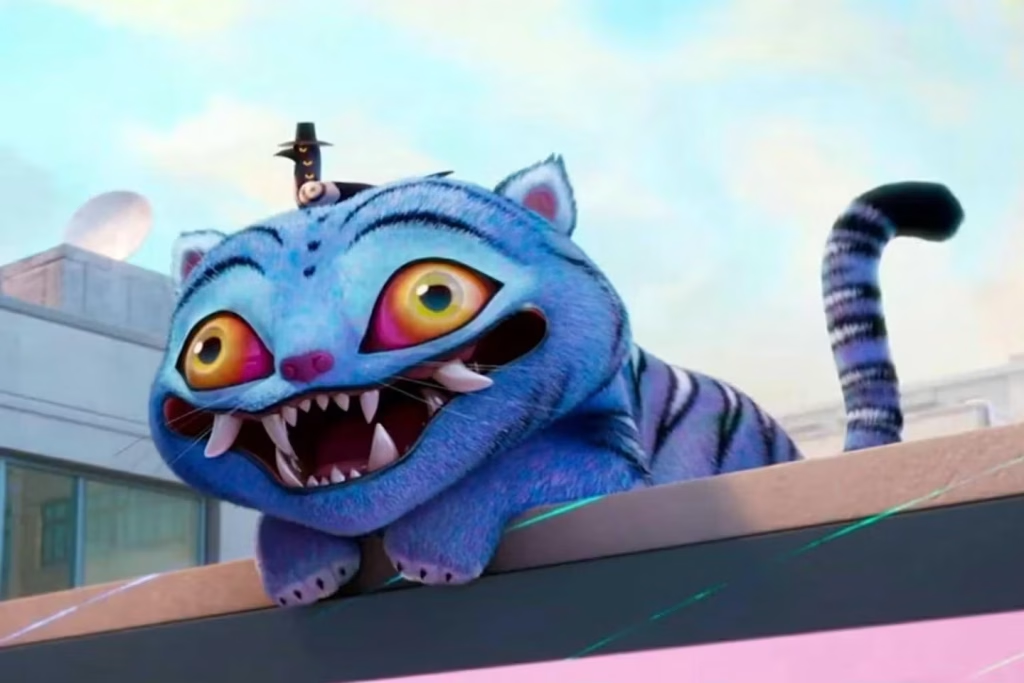
The final thing to know about KPop Demon Hunters revolves around the nature of the demons themselves. Just as with the characters who populate the world of Pokemon, the demons of KPop Demon Hunters are not really monsters, either. This statement will seem confusing when you get to watch the trailer and see it populated with monsters engaged in battle with the members of Huntrix. But trust me, those cartoonish monster demons were never meant to represent actual scary monsters. Instead, think upon the saying that occurs when someone you know may be suffering and we comment on them by saying that they sure have their personal demons in order to be like they are. The demons in KPop Demon Hunters are not meant to act as real monsters but instead, to act as mental health maladies that befall us all such as addiction, low self-esteem, self-doubt, impulsiveness and shame, for example. In the storyline, the members of the girl group Huntrix are all musicians whose twin jobs are to use their songs to maintain and reinforce a healing barrier called the Honmoon between their world and the underworld, all the while fighting off and destroying any demons they see. These demons are recognizable due to a series of stark patterns that appear on the human-like form they adopt once on the surface of the world. Every generation has its own version of Huntrix or the singing demon hunters. This particular group has been so successful that they are set to perform their new song called “Golden” at a special awards show. Once they perform the song live, the power of their voices and the words they convey will be enough to create a Golden Honmoon otherwise known as a permanent barrier between the two worlds. As a last ditch desperate gamble, the king of the underworld dispatches a boy band to counter Huntrix. This boy band is called The Saja Boys. One of the ways that the demon world calls to those souls in the real world is by whispering to them in their heads. In those whispers, the demon world plants seeds of self-doubt, selfishness, etc. that cause the afflicted to lose their belief in themselves and who they are and, by doing so, lose their souls to their own personal demons. Just as Huntrix is set to perform “Golden” live at the awards show, Rumi (the lead singer) begins to lose her ability to hit the powerful, high notes needed to seal the Honmoon forever. As it turns out, the demon world has been whispering to her because she has, what she refers to, as a secret shame. She is, in fact, a hybrid or half-breed…meaning that she is half human and half demon. Up until this time, Rumi had always kept her skin covered so as to hide the patterns she possesses on her skin. The crux of the rest of the movie involves the idea of how Rumi learns to accept and be proud of who she really is and to trust that those who matter most to her will accept her as she is in the end. Although the modern day ideas of being transgender and/or “coming out” as something other than hetero-normative are never mentioned at all in the movie, there are many fans who quite clearly view KPop Demon Hunters as showing what the process of dealing with the societal-imposed shame of “coming out” is really like for those who opt to live their lives that way. As the movie shows in the end, there is no shame when you are truly loved and valued by others and by yourself. And once that lesson has been learned by Rumi, she regains her voice and the Golden Honmoon unfurls its protective arms around the world.

The song “Golden” is sung near the beginning of the movie and is a type of song that is often used in musicals to introduce the main character(s), their circumstances and their hopes and dreams for the future. This type of song is often referred to as an “I want/wish” song. As such, in KPop Demon Hunters, “Golden” is sung in such a way that all three members get their moment to shine and tell their initial story. The song itself is forceful, peppy and entirely catchy, sung as it is in a combination of English and Korean thus, qualifying it as being authentically a KPop song. Just as “Let It Go” from Frozen was not only a showstopping piece of music but also a song that held much meaning to the storyline of the film, “Golden” will be one of the centerpieces of the upcoming Academy Awards show when it is broadcast in a few weeks. It is a great Pop tune that speaks to the nature of the main characters of the film and to their purpose for being there. As such, it is a worthy winner of every award for Best Original Song that it has won so far, with one more major award to come on Oscar night.

Without taking anything away from “Golden”, the whole KPop Demon Hunters soundtrack is loaded with potential hits. For what it is worth, “Golden” is not my personal pick for best song in this movie, although it is good and I like it. As mentioned previously, most musicals have a structure to the song placement in their stories. Toward the end, often the last or second last song, most musicals have a song that is referred to as the “eleven o’clock” song. This type of song is often a rousing, finale-esque song that acts to tie up the loose ends and bring the musical to a satisfying conclusion before the audience is dismissed to go home. In KPop Demon Hunters, the eleven o’clock song is titled “What It Sounds Like”. That song is sung as the epic final battle rages between good and evil, Huntrix and Saja Boys, the Honmoon and the underworld, as Rumi realizes the joy of finally acknowledging publicly who she has really been all along and finding out that her friends and bandmates still love her. It is this song that many point to as being the core “coming out” message of the movie. As such, the song is very uplifting and life-affirming. While my prediction of “Golden” winning the Academy Award for Best Original Song may not be that great of a stretch, here is a second prediction…”What It Sounds Like” will be, by no later that the summer of 2027, the worthy successor of “Pink Pony Club” by Chappell Roan as the darling of those view the phrase “Love is love” as being their mantra. It is just that good and, to many, just that important.

I began this post by referring to the state of our world and how many life-and-death battles are suddenly erupting in towns and cities all over America and, sooner or later, probably the world. However, as horrible as these battles are (especially to those who have lost family members to the violence), it is important to remember that battles and challenges take many forms. Some battles involve legislation and intimidation aimed at suppressing the rights of people with sexual orientations, skin colours or genders that differ from those of the ruling white males who govern us in many cases. Thus, when a movie comes along that appears to validate a group of people who, in real life and in real time, feel oppressed and alone, that movie takes on a state of importance that is most welcome. Finally, the state of our mental wellbeing has never been more under assault than it is today. That is one of the most devastating tactics being used right now by those in positions of authority. Just as Rumi did as she prepared to sing “Golden” and seal the Honmoon forever, thousands of citizens are hearing the whispers in their own ears that they are not welcome, they are not worthy and, most importantly, that they don’t belong. It is hard to withstand that form of gaslighting and psychological warfare on your own. We all need help and support from others in times like these. In Harry Potter, it was the strength of a mother’s love that protected Harry and allowed him to defeat Voldemort. Likewise, in the towns and cities where goon squads are presently wreaking havoc, it is that sense of community and empathy and friendship that are allowing targeted citizens to withstand those assaults in one piece so far. Good can triumph over evil when we care about one another and value the true essence of who we are. Love trumps hate. It has in the past and can do so again in the present. That’s why a seemingly child-like movie such as KPop Demon Hunters matters and why it has resonated so deeply with so many people all over the world. In a cinematic sense, I am not saying that this is the very best movie I have ever seen. It is not. But it is just the first of several that are surely to follow as we witness the birth of a new entertainment franchise. KPop Demon Hunters is a movie fit for the times in which it has been released. It is light, breezy and yet, life-altering for many…and its soundtracks slaps, as many KPop songs do in real life. I recommend it, especially if you are feeling weighed down by the voices in your head that are telling you that you don’t matter. You do matter. We all do. No amount of nonsensical utterances from the underworld can change that. Stay strong everyone!
The link to the video for the song “Golden” as voiced by singers EJAE, Audrey Nina and REI AMI from the original motion picture soundtrack from the film KPop Demon Hunters can be found here. The lyrics version is here.
The link to the video for the song “What It Sounds Like” as voiced by singer EJAE, Andrey Nina and REI AMI from the original motion picture soundtrack from the film KPop Demon Hunters can be found here. The lyrics version is here.
The link to the video for the movie trailer for the film KPop Demon Hunters can be found here.
***As always, all original content contained in this post remains the sole property of the author. No portion of this post shall be reblogged, copied or shared in any manner without the express written consent of the author. ©2026 http://www.tommacinneswriter.com