
Imagine creating a song, a poem, even a catchphrase that is so instantly iconic that everyone assumes your creation is something that is so woven into the fabric of our culture as to have been here for hundreds of years already. Well, that is what Wade Hemsworth managed to accomplish in the 1950s with a single album of twenty songs that he called Folks Songs of the Canadian North Woods. From that one album came a series of songs about life in the northern parts of Ontario and Quebec that Hemsworth was able to observe during a stint as a surveyor after World War II. “Donkey Riding”, “The Black Fly Song”, “The Wild Goose” and “The Log Driver’s Waltz” were all folk songs that immediately had an ancient, timeless air about them. These songs spoke with intimacy about the details of lives spent far from the bright lights of Canada’s biggest cities. Each song on Folk Songs of the Canadian North Woods sketched a portrait of the challenges and the joys of living on The Canadian Shield, which is home to some of the grandest stretches of nature the world has to offer. Water, rock and trees for as far as the eye could see, that’s what Wade Hemsworth was surveying in the middle of the 1950s when he took pencil to paper and wrote his twenty songs.
The rules of polite society didn’t always apply to the small work camps that Hemsworth came across during his surveying work, isolated as they were amid an ocean of forest. In those camps, rugged, ragged men were tasked with attempting to bring order to the wilderness. By day they hacked at monstrous trees with their blades of steel. By night they drank and they sang and they fought, only to rise with the sun to do battle with the forest once again. There are many elements to the mythology of nations. For Canada, one of those elements surrounds that of the burly lumberjack. On a grander level, the lumberjack was, quite literally, on the cutting edge of colonial expansion westward across the land that was to become Canada. It was the lumberjack who cleared the land while simultaneously providing the wood needed to build permanent settlements in resource-rich regions of this new country. It was the men of the work camps who cleared pathways through the forest that became roadways for the transportation of goods to more established centres in the south. While the above is certainly a simplified look at how Canada was initially settled and colonized, it is not an understatement to say that the Canada we have come to know was built upon the backs of these men known to the world as plaid shirted, toque wearing Canadian lumberjacks.

But when Wade Hemsworth came across these work camps in the northern woods while he was surveying, it wasn’t big picture work that he was witnessing. Instead, he saw the detailed process of how the wilderness of Canada was brought to heel. It was a process for which the felling of a tree was merely the first step. If you have ever had the misfortune of having a tree fall over on your property in a windstorm, you know what a big job it is to move the fallen tree out of the way. Trees are large, dense, heavy objects. In the middle of the primeval forest, once a lumberjack cut down a tree, next came the multi-step task of preparing the fallen tree to be moved. Back in the day, that process began with the cutting off of tree limbs. With the limbs removed, the lumberjacks were left with a piece of untreated wood that became known as a log. In the days before large transport trucks and trains were in use, the most common method of bringing these heavy logs to southern pulp and paper mills for processing was by moving them to/dropping them into a fast flowing river and floating the logs downstream. One final team of men were given the responsibility of guiding the logs on their journey down river. These men would become known as the log drivers.

Like many things in life, the processes by which things happen often are refined over time by virtue of many instances of trial and error. Getting the logs safely and efficiently down a river was initially thought to be a simple process. The logs would float, the current would provide momentum and the end result would be a series of logs merrily floating down the river until they arrived at their destination some kilometres later. Unfortunately, not all rivers flow in straight paths. There were bends in these rivers, along with rocks and rapids, too. Because of these obstacles, the logs developed a great tendency to pile into each other or else get tangled on overhanging branches and stumps and rocks along the shoreline. Once the logs began to jam up, the entire river could become blocked. Furthermore, the log jam often formed in a dam-like fashion which, in turn, could cause flooding of the surrounding land. In an attempt to keep log jams to a minimum, a specialized group of men were trained in the art of log driving. This skilled trade involved the log driver actually standing on the logs as they flowed down the river. Each man would have a long pole that they would use to poke, prod and pull at the logs as they moved in order to keep them from bunching up. As the men jumped from one log to the other, these logs would spin and turn in the water. Consequently, a log driver needed to have great agility and balance in order to remain upright on his feet on a spinning log in a fast flowing river. This balancing act became known as “birling”. I mention this because Wade Hemsworth observed the log drivers at work and thought that their birling seemed to be almost like dancing. Except, in the case of the log drivers, they weren’t dancing with their best girl, they were dancing with a long metal pole and a river filled with huge logs. This dangerous dance inspired Hemsworth to write the lyrics for a song that has easily become one of the most famous songs in our country’s music history called “The Log Driver’s Waltz”.

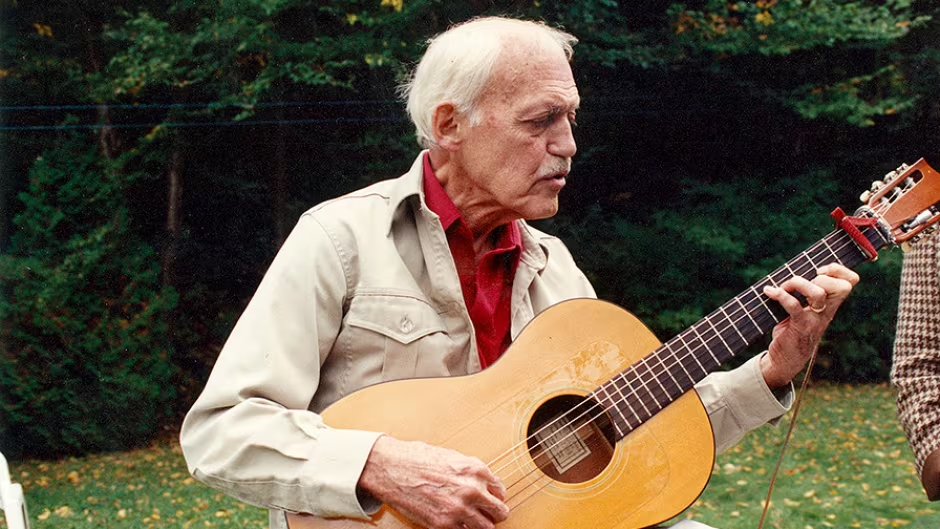
Hemsworth wrote the song, along with nineteen other tunes that he had been inspired to write during his time as a surveyor in the northern forests of Quebec and Ontario. He was convinced to record his songs on an album. That album was released to very little acclaim. Wade Hemsworth didn’t mind because he had never intended to become a music star. He wrote the songs in order to help him to remember his experiences in the north. Once the album was finished, Hemsworth went on with his life, becoming an employee of the Canadian National Railway. Sometimes, when the mood struck, Wade Hemsworth could be convinced to take out an acoustic guitar and regale an gathered crowd with renditions of his songs. His music was always warmly received, which brought him a certain amount of personal satisfaction.
The music of Folk Songs of the Canadian North Woods may have faded into obscurity if not for an upswing in the popularity of folk music in North America as the 1950s ended and the 1960s began. Singers like Bob Dylan, Joan Baez and Pete Seeger in the United States, along with Joni Mitchell and Gordon Lightfoot in Canada helped fuel a revival of this music form. In Montreal, a folk music quartet formed that was called The Mountain City Four. That group included Jack Nissenson, Peter Weldon and two teenage sisters named Kate and Anna McGarrigle. In the mid-1960s, this folk group sought to sing folk songs from the great Canadian songbook. Unfortunately, Canada was a country that had not reached its first century mark yet so the songbook wasn’t that extensive then. But included in our national canon at that point was an album filled with songs about life in the northern woods of Quebec and Ontario. The Mountain City Four fell in love with Wade Hemsworth’s music and recorded several of his songs, including “The Log Driver’s Waltz”.

Their recording of “The Log Driver’s Waltz” happened to coincide with a great uptick in national pride all across the country as Canada prepared to celebrate its centennial year in 1967. As part of the official plans for the centennial celebrations, the Government of Canada-funded agency known as The National Film Board of Canada stated that a central part of its mission was to create and/or promote films that represented essential elements of Canadian culture and to preserve them as historical artifacts going forward. A call was sent out to film makers and animators across the land for projects that might fall under the N.F.B.’s mandate. As this call was being made, The Mountain City Four were enjoying a moderate level of success in Montreal with their rendition of “The Log Driver’s Waltz”. Because of the visually descriptive nature of the song about studly men dancing suggestively on spinning logs in the water, the idea of turning “The Log Driver’s Waltz” into an animated short film was hatched. A decade or so later, as part of the National Film Board of Canada’s official series entitled Canada Vignettes, “The Log Driver’s Waltz” animated film made its debut. In the time since then, this film has been nominated for an Academy award for Best Animated Short Film (it did not win) and has gone on to become the all-time most viewed/downloaded film ever produced by the N.F.B.
“The Log Driver’s Waltz” film, with the music of the Mountain City Four, has become a song that is regularly taught and shown in schools all across the country. It has served to firmly establish the romantic mythology of the backwoods lumberjack as a builder of this nation. It has also helped to ensure that the original song by Wade Hemsworth has taken on the air of being part of Canadian folklore.
Hemsworth’s version of “The Log Driver’s Waltz” feels like it has always been sung, even before that act of Confederation in 1867 brought Canada into being. But the fact of the matter is that Wade Hemsowrth recorded Folk Songs of the Canadian North Woods the very same year that Elvis Presley debuted with his cover of “Blue Suede Shoes”. “The Log Driver’s Waltz” may read like ancient history but it was written and recorded in modern times, so to speak. After Hemsworth retired, he settled in the Laurentian Mountains in Quebec where he wrote a book called The Songs of Wade Hemsworth. At the age of 79, Hemsworth recorded a new album of songs that he had written about in his book. As a result of this new album, Hemsworth was invited to perform at the Winnipeg Folk Festival. His performance was filmed by the CBC. Wade Hemsworth passed away in 2002. He was inducted the following year into the Canadian Songwriters Hall of Fame in 2003. Upon the occasion of his death, Wade Hemsworth was eulogized by Peter Weldon as being “The first really original songwriter this country has ever produced.” The McGarrigle Sisters stated that for their career they had only two important musical influences, one was Bob Dylan and the other was Wade Hemsworth. Although Mr. Hemsworth may have left us, his music has helped to define our nation unlike few others have managed to do. We are all richer for his efforts.
The link to the video for “The Log Driver’s Waltz” from the National Film Board of Canada, as sung by the Mountain City Four can be found here. ***The lyrics version is here.
The link to the official website for Wade Hemsworth can be found here.
The link to the official website of the Mountain City Four can be found here.
The link to the official website for Kate and Anna McGarrigle can be found here.
The link to the official website for The National Film Board of Canada can be found here.
Finally, the link to the official website for the Laurentian Mountains in Quebec (that Wade Hemsworth so loved) can be found here.
***As always, all original content contained within this post remains the sole property of the author. No portion of this post shall be reblogged, copied or shared in any manner without the express written consent of the author. ©2024 http://www.tommacinneswriter.com