
Many of the live music venues profiled so far in this series have gained their fame due to the historical significance of the building, the purity of the acoustics, the beauty of the architecture and/or because of some fabulously noteworthy moment in musical history having happened there. Today’s post is about a venue that was never intended to be a music venue in the first place. The inclusion of the Altamont Speedway in this series of iconic venues is for reasons not already listed above. The Altamont Speedway is here because one of music history’s darkest moments happened at this site. The events of December 6, 1969 impacted the world of music and the societal structure of a nation in ways that still reverberate to this very day. It is my hope to succinctly chronicle the events of that day and show why the Altamont Free Concert devolved into such a scene of violence, chaos and degradation that it is still referenced almost sixty years later as being Rock n’ Roll’s worst moment ever. Usually it is my hope that you will sit back and enjoy the stories that I share. Today is not one of those times. In today’s post I am asking you to bear witness. Let us begin.
The Altamont Free Concert:
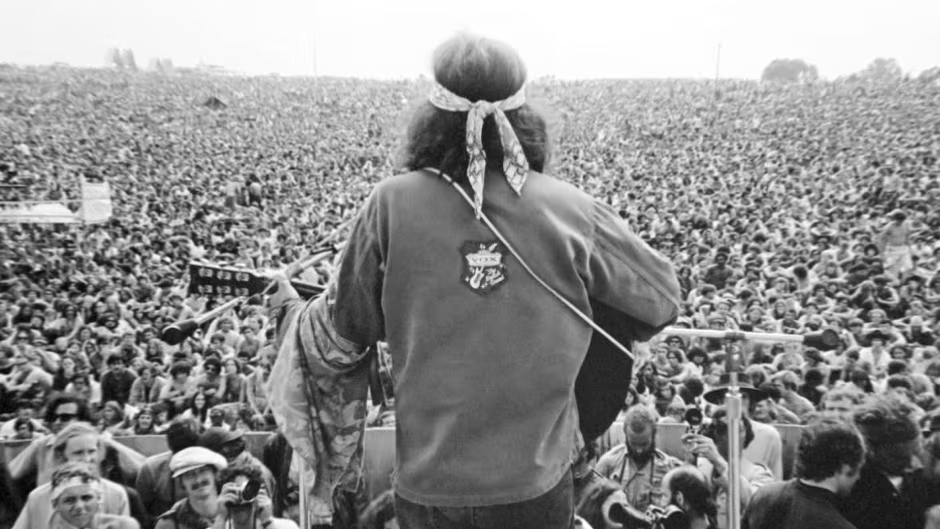
Four months prior, Woodstock had happened. The Woodstock Music Festival in Bethel, New York is regarded as one of the high points of the Hippie Movement and all that it entailed as it took root in America. It was a concert that showcased some of the biggest rock acts of the day and did so with an audience that numbered into the hundreds of thousands. The legacy of Woodstock was one of peacefulness and love and community being put into practice. There was a sense of hopefulness for the future. It was counter-culture politics set to a musical beat. Fast forward a mere four months, members of west coast bands such as The Grateful Dead and Jefferson Airplane decided that if the east coast could put on a show like Woodstock then something similar should be attempted on their home turf in the western United States. Thus, a formal effort was established to find a site for such a one day free concert. After being rejected by city after city, stadium after stadium, organizers of the event were given permission to make use of the Altamont Speedway in Tracy, California. Tracy is located eqi-distance east of San Francisco and San Jose and south of Sacramento. The agreement to use the Altamont Speedway site was arrived at on December 4th. The concert was scheduled for two days later.
The Line-up:
The one-day festival lineup was advertised as being Carlos Santana, Jefferson Airplane, The Flying Burrito Brothers, Crosby, Stills, Nash and Young, The Grateful Dead and The Rolling Stones. The musical acts are listed in the order that they were scheduled to appear. Not too shabby of a lineup for a free concert!

The Altamount Speedway Site:
The Altamont Speedway was usually used to hold car races. It featured an oval track that sat low on the ground. The racing oval was surrounded on all sides by sloping hills, giving the Speedway and bowl-like appearance. Because there was so little time between when the agreement was signed to hold the free concert at the Altamont Speedway site and the date of the actual concert, there was little time to transform the venue from a spectator-oriented racing venue to a more intimate concert venue with an expected audience size of 100,000 people. As such, the only structural modification of note was the construction of a small stage, four feet high off of the ground (not much higher than your own kitchen or dining room table), to be placed in the middle of the car racing infield. There was no additional seating installed. There were no additional portable bathrooms brought in. There were no formal entrance or exit ways erected. When the day of the concert arrived, all that was there was a small stage in a big field. The only thing separating the stage from the field was a single strand of rope held in place by metal pegs hammered into the ground.

Safety and Security:
It is a normal state of affairs for concert organizers to hire private security people to patrol the event space before, during and after a live concert takes place. Often, these security people are off-duty police officers. Because these folks are well schooled in the practice of creating and maintaining social environments with safety and security in mind, the vast majority of live music events go off in a peaceful, uneventful manner. That was not the case at the Altamont Free Concert. In a laundry list of poor decisions, one of the most controversial that was made by those in charge of this event was the decision to hire members of the local chapters of the Oakland and San Francisco Hells Angels motorcycle gang as security for this concert. Apparently, the Hells Angels had provided “security” at several concerts in southern California at which there had been no incidents of note. For the Altamont Free Concert, the Hells Angels refused to act as police for the concert. They had no interest in monitoring behaviour out in the audience, being responsible for the orderly entering/exiting the event grounds, etc. Instead, the Hells Angels were tasked with “securing the stage”. This meant in practice that the Hells Angels were to form a protective buffer between the performers on the stage and the audience watching the show only a few feet away. Organizers of the concert told the Hells Angels that they were free to sit on the edge of the stage throughout the concert. Payment for this service was in the form of all the beer the Hells Angels could consume.

The Day of the Concert:
December 6, 1969 turned out to be a stereotypically warm and sunny California day. Because the day was so nice and the concert lineup so appealing, over three hundred thousand people descended on Tracy, California. The grounds of the Altamount Speedway quickly filled to overflowing. There were copious amounts of drugs being used by concert goers. There was no one there to police their use. The sun shone down brightly on a sea of people who had no shade to huddle beneath. Remember, there was no water or concession stands of note available for such a large audience. There were few, if any seats available so most people crowded together on the ground. The stage area was dwarfed by the mass of people in attendance. The thin rope barrier initially set out to define a separation of space between the audience and the stage was quickly overwhelmed and knocked down. The Hells Angels began drinking almost immediately upon their arrival. The fans pressed ever closer to the stage. The Hells Angels, always spoiling for a fight, began “securing the stage” by beating fans closest to them. Sometimes, the Hells Angels used their fists and their feet but they also brought with them chains and pool cues, both of which were used as weapons.

The Performances:
Grace Slick, lead singer of Jefferson Airplane, had performed at Woodstock in front of an extremely large crowd there, too. However, upon appearing at Altamount, she immediately remarked that the vibe was vastly different. There was tension and anger and frustration everywhere, seemingly all at once. Of all of the acts that performed that day, only The Flying Burrito Brothers managed to get through their set without being interrupted by violence. Carlos Santana, who opened the concert, had his set interrupted when fights broke out near the stage. During the next set by Jefferson Airplane, band founder Marty Balin left the stage and entered the audience area to try and quell some of the simmering violence that was happening. For his efforts, Balin was punched unconscious by a member of the Hells Angels. Upon hearing of Balin’s assault, the members of The Grateful Dead unanimously agreed that it was too dangerous to perform and they immediately withdrew from the lineup. When CSNY took the stage, singer Stephen Stills was repeatedly stabbed in the leg with a sharpened coat hanger by a member of the Hells Angels. In essence, the stage became like a prison for those attempting to perform upon it. They were defenseless amid the violence that was erupting all around them. One would like to think that being celebrities as they were, that the admonishments from these music stars would hold some sway when it came to maintaining order at the concert. But the fact was that at some point during the first half of the free concert, a primal tipping point was reached from which there would be no restoration of order. A spasm of violence-fuelled testosterone erupted between the Hells Angels and the audience and between the Hells Angels and the performers. In the aftermath of it all, four people would be dead, dozens injured and the reputations of many people, including the Rolling Stones themselves, would never be the same again.

The Rolling Stones:
The Rolling Stones were the concert’s closing act. Next to The Beatles, The Rolling Stones were the biggest band in the world at the time. Many people feel that it was their inclusion on the bill of the concert that was responsible for much of what transpired. The reasoning goes like this. The Rolling Stones were included in the lineup of this concert primarily because they had already been on tour in the United States. While that tour had gone reasonably well, there were complaints from members of the public that ticket prices were inflated and that band merchandise was too highly priced. Stung by this criticism, the Rolling Stones quickly leapt on the bandwagon when news of a possible “West Coast Woodstock” started making the rounds. The Stones felt as though being part of a free concert would act to counterbalance the perception that they were price-gouging their fans. However, it was the very inclusion of The Rolling Stones in the lineup that caused city after city to turn concert organizers down when permission was being sought for a venue to hold the concert. Most communities were wary of the Rolling Stones reputation as the anti-Beatles, the darkness to the Fab Four’s light. City Council members of various communities worried that the Rolling Stones would attract an unsavory element to their show and, as such, demands were made that the Rolling Stones personally should ante up damage waiver guarantees totalling into the hundreds of thousands of dollars. The Rolling Stones refused these demands again and again, as city after city turned their backs on hosting the free concert. It was specifically because of these damage waiver guarantees that the free concert ended up being all the way at Altamont Speedway in Tracy, California, instead of a proper music venue somewhere else.
The Rolling Stones Arrive At Altamont Speedway:
The Rolling Stones arrived at Altamont Speedway by helicopter (which would prove important as events deteriorated later on during their set). Immediately upon leaving the helicopter, Mick Jagger was assaulted by a fan who punched him in the face. There was no organized way for the band members to access the stage. They found themselves amid a sea of drugged out, sunbaked, dehydrated fans who had been waiting over an hour for the band to show up. Slowly making their way to the stage, The Rolling Stones arrived to find Hells Angels members on the stage waiting for them. These men regarded Mick Jagger, in particular, with contempt and refused his requests to leave the stage area so the band could perform. It was apparent right from the moment the band reached the stage that Mick Jagger was not in control of the concert, in any way, shape or form. The Stones decided that the best course of action was to start playing in the hope that their music would calm everyone down. So, in the middle of burly Hells Angels “security guards”, the band began to play.

The Death of Meredith Hunter:
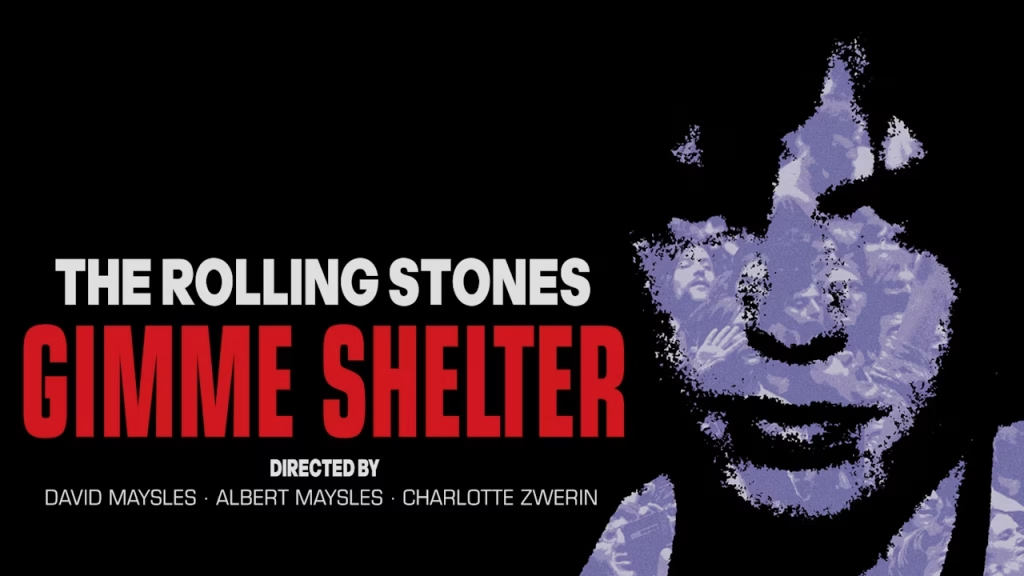
Three songs into their set, a nineteen year old black man named Meredith Hunter was stabbed to death by a member of the Hells Angels as he approached the stage. Initially, it was reported that Hunter was a victim of unprovoked racial violence and, as such, his death was most tragic and symbolic. However, unbeknownst to many people involved in the concert, the entire concert was being recorded by documentary filmmakers named the Maysles Brothers. Albert and David Maysles had been recording the band throughout their U.S. tour. It was during the editing process for the documentary film Gimme Shelter that the Maysles brothers discovered that during the filming of the band performing on stage, they had accidentally filmed Meredith Hunter being stabbed. The film footage of the incident would play a crucial role in the many court cases that came to be filed in the aftermath of this very public murder. What this new film evidence showed was that Meredith Hunter had approached the stage minutes before his death. He was dressed in a lime green suit (!). From his mannerisms, Hunter gave the appearance of being under the influence of drugs or alcohol. As Hunter first approached the stage, he was rebuffed by members of the Hells Angels and chased back into the crowd. It appeared that the Hells Angels members assaulted Hunter and hurled racial insults at him as they followed him into the crowd. A few minutes later, Hunter had reoriented himself. He approached the stage again, only this time he had drawn a gun and was holding it aloft. It is not clear if Hunter intended to shoot one of the members of the Rolling Stones or a member of the Hells Angels. But, in any case, the sight of Hunter holding a raised firearm caused an immediate and deadly reaction from one member of the Hells Angels who tackled Hunter and stabbed him repeatedly. As the stabbing was taking place, the Rolling Stones stopped playing. There is a photo that shows Mick Jagger staring helplessly at the melee taking place by the side of the stage. At this time, he did not know that a stabbing had occurred and that Meredith Hunter was bleeding to death mere feet away. The decision was made by the band to continue to play, In their minds, aborting the concert could cause a full blown riot to occur. So, the band played on. Meanwhile, concerned concert goers lifted Meredith Hunter’s body and moved him to the small medical tent located to the side of the stage. The doctor there examined Hunter, who was still alive at this point, and determined that emergency surgery was necessary to staunch the bleeding. The doctor asked the managers of The Rolling Stones if Hunter could be airlifted to hospital using their helicopter. His request was denied by the Stones’ management team, fearing that the helicopter was the only safe way the band was going to get out of the concert alive when their set was done. Thus, an ambulance was called. In the time it took for the ambulance to arrive and the paramedics to reach Meredith Hunter, he had bled out and passed away. The Rolling Stones finished their set and were airlifted to the safety of their hotel. After the concert ended and audience members tried to go back to their homes, one intoxicated concert goer fell into a nearby irrigation canal and drowned. Two others were killed after they were hit by a car out on the highway.

The Aftermath:
The death, violence and destruction of property that came to be associated with the Altamont Free Concert were shocking for many when the exact details started coming to life. The shockwaves that reverberated outward did so in multiple ways and at multiple levels. First of all, an investigation was launched into the death of Meredith Hunter. The member of the Hells Angels who had stabbed him was charged with murder. The Maysles Brothers’ film segment was entered as a crucial piece of evidence. Based upon what the jury saw in that film, they concluded that the Hells Angels enforcer acted without murderous intent and that, in fact, the raised gun held by Meredith Hunter made the stabbing an actual act of self-defense. That a white man could brazenly kill a black man, be filmed in the act and still be exonerated raised accusations of systemic racism that still permeate society to this very day. Members of Meredith Hunter’s family sued the owners of the Altamont Speedway and the Rolling Stones for Hunter’s death. They settled out of court for $10,000.
Over time, many people began to examine the actions and motives of The Rolling Stones in this whole incident. Accusations were brought against the band for willingly taking part in the creation of an environment that wasn’t safe for concert goers or for performers, all so that they could rehabilitate their public image, while recording footage for a documentary that would make them money. The Rolling Stones have never really been held accountable for the role they played in this whole tragedy. The band generates too much money for too many important people for them to truly ever be brought to justice. For his part, at the time a clearly shaken Mick Jagger admitted regret over Meredith Hunter’s death and for the violent nature of the concert but never accepted any form of responsibility for any of what went wrong. Keith Richards being Keith Richards deemed the Altamont free concert as being, “on the whole, a good show”. The Rolling Stones continue to tour to this very day.
On a societal level, the combination of the drug-fuelled violence of Altamont and the murderous rampage of the hippie-like Manson Family members, caused many to re-evaluate how realistic the peace-filled mantras of the Hippie Movement actually were. It is important to remember that the Hippie Movement was a counter-cultural movement that was challenging the policies of the established status quo-loving powers that be. Any hint that the Hippies’ beliefs were not as stable and strong as they were being portrayed (especially after Woodstock) was something that the establishment eagerly seized upon to denigrate the movement going forward. Societal change is never easy. Revolutions are not for the meek or the overly idealistic. All the authoritarianism and populism we face today is not directly the result of the idealism that was snuffed out after Altamont and the Manson Family killings but, make no mistake, those events both provided ammunition for those who sought to perpetuate the status quo in our society. A lot of generational innocence was lost because of the Altamont Free Concert, as Don McLean sums up in the fifth verse of his iconic hit “American Pie”:
“Oh, and there we were all in one place
A generation lost in space
With no time left to start again
So come on Jack be nimble, Jack be quick
Jack Flash sat on a candlestick
‘Cause fire is the devil’s only friend
Oh, and as I watched him on the stage
My hands were clenched in fists of rage
No angel born in Hell
Could break that Satan’s spell
And as the flames climbed high into the night
To light the sacrificial rite
I saw Satan laughing with delight
The day the music died”
- Don McLean, “American Pie”.
***As always, all original content contained within this post remains the sole property of the author. No portion of this post shall be reblogged, copied or shared in any manner without the express written consent of the author. ©2024 http://www.tommacinneswriter.com