This past week I attended a Remembrance Day service in the town next to where I live. It was a well attended ceremony with several hundred in attendance. The service was suitably solemn. Heads were bowed. Cell phones were set to silent. Wreaths were laid at the base of the cenotaph. Songs of peace were sung by school choirs. A lone military plane flew past. At exactly 11:11 in the morning, a member of the local chapter of the Cadets stepped forward and played “The Last Post” on a trumpet. Flags flapped in the breeze. No one spoke. Everyone stood stock still. It was all as an act of remembrance should be. And yet, somehow it felt different this year.
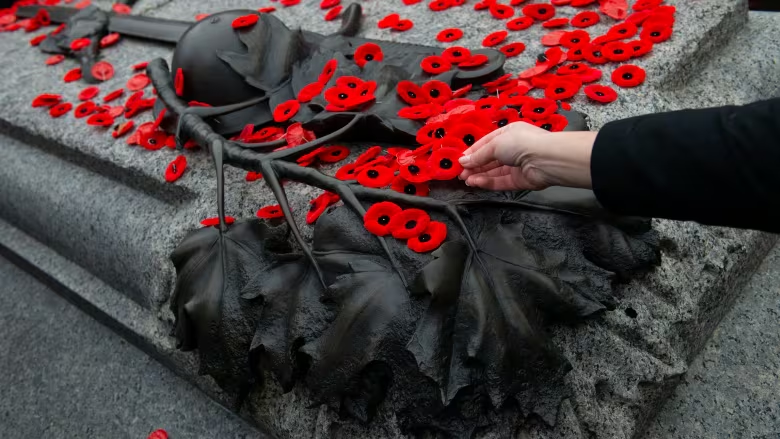
I have spent the entire length of my existence living in a country in which those who went to war in WWI and WWII were revered for their courage and for their sacrifice. The myth making story that emerged from those wars was that our soldiers made the ultimate sacrifice in defense of higher ideals of freedom and democracy. It was said that these brave souls defeated the forces of tyranny and oppression and, by doing so, ensured that regular folks like me would have the freedom to live a life filled with peace. And so I have. No bomb has ever blown up in my town. No bullet has ever left its mark near my home. No external threat has ever been so great that I feared for my life, the lives of my loved ones or for our future in this peaceful country called Canada. And yet, somehow it feels different this year.
Throughout the course of my life, the political organization of the world seemed fairly set. There were democratic countries like mine in which citizens had a say in who got to sit in the seats of authority. This happened by virtue of free and fair elections. Our ballot was our bullet. Our votes determined which way the political winds would blow. Sometimes our leadership suited our tastes and we celebrated their electoral victories. Sometimes the tides turned and leaders were elected whose policies we may have disagreed with. But even in those times, we knew that we only had to endure those policies until the next election, at which time we would have a chance to reverse our political fortunes. Even in those so called “bad times”, life went on pretty much as it had because that was how it was living in a democratic country. There would always be a chance to make your voice heard because you always had the next election to count on where your vote could matter. And yet, somehow it feels different this year.
One of the things that comes part and parcel with living in a country where democratic principles form the foundation of your society is that you get the chance to debate morality at the very highest levels. Morality is one of the things that has always separated us from robots and autocrats. The moral choice isn’t always the most logical choice when it comes to how a country is run but for the time I have been alive, morality has been interwoven into the story of Remembrance Day. In fact, the moral imperative to defeat the forces of fascism was the single most significant aspect of why our soldiers have always been held in such high regard. Using the strength and courage of our moral convictions has always been seen as a virtue. And yet, somehow it feels different this year.
As WWII was in its earliest stages, debates about morality were taking place at the highest levels of American society. Whether or not to enter the war was the subject of fierce conjecture. At the heart of that debate was a tug of war over whether America had a moral obligation toward helping other countries at the cost of many lives and many dollars or was America better served by an isolationist America-first policy? As you may know from reading the recent John Prine post for the song “Paradise”, Franklin Delano Roosevelt came into office as president just as the Great Depression was ending. Big societal events such as the Great Depression or, in our times, the COVID pandemic, often present those in power with the opportunity to enact change. For FDR, one of the changes he wanted to make in American society was to wrest some of the growing influence of the billionaire class. At that time, as the Great Depression helped make clear, too much power was concentrated in the hands of too few people and, as a result, it made rectifying the impact of the economic downturn more difficult for the national government. In simplistic terms, this caused FDR to bring for his New Deal policies that, at their core, served to give the democratically elected government more control over policies that directly affected the lives of American voters. Investing money in many of the make-work projects that evolved out of the New Deal didn’t always make financial sense. But FDR knew that it was important for the common man to feel valued and seen. One of the ways to best do that was by providing employment opportunities that, in turn, allowed these men to earn a living and provide for their families.

While the New Deal was unfolding, debate arose about whether or not American interests would be better served by sitting out WWII. The idea of there being a collective sense of responsibility by America to other democratic, like-minded countries was not something that was set in stone. In fact, the cover of the popular magazine called Life famously declared that it was the “Century of America”. This was isolationist politics. In response, FDR’s Vice President Henry A. Wallace gave a famous speech entitled “The Century of the Common Man”. This speech set out to give voice to FDR’s vision of creating a nation that recognized that its strength lay in its people. In essence, it laid out a vision whereby the welfare of the common man was at the heart of American political policy. The speech was also given as debate swirled through the corridors of power as to whether or not the war should be entered at all.

In this atmosphere, the Arts came to make an enormous impact. There was a man named Eugene Goossens who was the conductor of the Cincinnati Symphony Orchestra. Mr. Goossens was a world traveller and was very familiar with some of the patriotic marches and symphonies that had been created in other nations of the world. Goossens wanted to help develop that tradition in America so he sent out a notice to a variety of American composers seeking pieces of patriotic music. He received several dozen compositions in reply. The most famous of these came from composer Aaron Copland. *(I have written previously about Copland here). Copland had been inspired by Vice President Wallace’s speech and created a piece of music called a fanfare in response. A fanfare is a piece of music, most commonly encompassing patriotic themes, that features brass instruments most prominently. Copland called his composition “Fanfare For The Common Man”. *(You can listen to it here). This fanfare went on to become the most popular piece of music out of those commissioned by Eugene Goossens. And while “Fanfare For The Common Man” by Aaron Copland did not single-handedly swing the debate about whether or not to enter WWII…*(A little event called the Attack on Pearl Harbour may have also played a role), this piece did create a soundtrack that contributed to feelings of patriotism among the American people. As I always say, in times of darkness and/or doubt, the Arts will show a way forward. It certainly contributed a lot to this debate. As a result, America entered the War. Its’ participation was a crucial factor in helping the Allied countries to turn back the momentum gained by the German Nazi Party. In the bigger picture, Americans opted for a policy that leaned toward that sense of collective responsibility. It meant that America would work to ensure that the rise of fascism would never again reach the height that it did in the early 1940s. Organizations such as NATO and the United Nations are symbolic of that political philosophy.

If you have ever watched the Steven Spielberg movie called Saving Private Ryan then you will have watched a movie that many soldiers have deemed to be the most realistic war movie ever made. This is particularly true of the invasion of Normandy scene that dominates the early stages of the film. The premise of this movie centered on a famous incident from the Civil War and a letter regarding that incident that was written by then president Abraham Lincoln. This letter is called The Bixby Letter. It was written by President Lincoln to a mother whose last name was Bixby. The reason he wrote this letter was in response to news that all five of her sons had died in battle. That turned out not to be entirely true but, at the time, President Lincoln felt obligated to reach out to this woman in her moment of unspeakable loss in an effort to “assuage the anguish of your bereavement” and to offer the gratitude of the American nation for her family’s ultimate sacrifice. Well, in Saving Private Ryan, the Army becomes aware that all of the Ryan brothers who had enlisted had been killed in action except for one. Young Private James Ryan was alive but behind enemy lines. A group of soldiers is sent on a special mission to rescue him so that he can be sent home. Apparently, as a result of the Civil War/Bixby Family situation, it had become formal policy that no other American family would lose all of its children to war ever again. In the movie, the Bixby Letter is read aloud in a meeting of officers. *(You can watch that scene here). It is used to justify the decision to send a group of soldiers on this very difficult and deadly mission to rescue a young soldier who doesn’t even want to be rescued. Private Ryan is embarrassed by it all and wants to stay and fight. That request is ultimately denied.

Ryan lives to survive the war. As a result, the opening scene of this movie is one in which Ryan, now an old man, attends a memorial service being held at an American war cemetery in France. As Ryan walks through the cemetery, he finds the tombstone of the man who saved his life. He is followed closely by members of his family who are alive only due to the fact that he was rescued. As Ryan walks through the cemetery, a piece of music called “Hymn To The Fallen” by composer John Williams plays in the background. *(You can listen to this piece of music here). This piece of music was directly inspired by Copland’s “Fanfare For The Common Man”. In fact, many people initially thought that it was actually Copland’s music that was playing as the movie opens. It was not. It was William’s tribute to Copland and to the ideals encompassed in that composition that plays instead.
Words and music in combination have the power to change history. They can inspire us to be better versions of ourselves. They also inspire us to feel a sense of responsibility to others in ways that are their own reward. There is a reason why a fanfare like “The Last Post” is played at Remembrance Day services across Canada. That piece of music evokes feelings within our hearts. Those feelings have dovetailed nicely with my own feelings about being a small but connected part of something bigger than myself. For my entire life I have lived in a country whose biggest city has an airport named in honor of the man credited with establishing the U.N Peacekeepers programme, Lester B. Pearson. Canada has always espoused ideals of helping to make our world a better place. Whether it is music like “The Last Post”, “Fanfare For The Common Man” or “Hymn For The Fallen”, music has been often used to create feelings within us that justify the sacrifices made by those brave men and women who served in our armies and fought against fascism and oppression because it was the right thing to do. Our soldiers didn’t fight to secure oil wells or to gain land that wasn’t ours so that our country could have Lebensraum or living space. They fought because our way of life seemed at peril. Our freedom to live in peace was at risk. We have been continuing to protect those hard won freedoms by voting in fair and free elections ever since. And yet somehow this year it all feels different.
As I stood there on November 11th and listened to the playing of “The Last Post”, I did so with a bemused outlook on it all. It was the same words of sombre reflection read aloud. It was the same promise of “Never again”. The music sounded the same but, at the same time, it sounded completely empty and devoid of meaning. What did those sacrifices even mean now in light of the outcome of the most recent U.S. election? It appears that the war of individualism versus collectivism has taken a sharp turn. By using ballots instead of bullets, disinformation in place of reasoned debate, division instead of unity, the forces of fascism and self-interest have taken control of America. President-elect Trump is promising to undo decades of global cooperation and collective action within his first 100 days in office. If NATO is broken up and the United Nations ceases to amount to anything of note then, who will stand alongside other countries of the world when troubled times befall them? What is to stop fascism from slowly creeping over the entire planet? In a new world order guided by principles of self-interest, will there be anyone left who will stand up and fight simply because it is the right thing to do? Does anyone anywhere still truly care about the common man? Somehow it just doesn’t feel the same anymore.
The link to the official website for the United Nations can be found here.
The link to the official website for N.A.T.O. can be found here.
The link to the official website for composer Aaron Copland can be found here.
The link to the video for the trailer for the film Saving Private Ryan can be found here.
The link to the official website for the Royal Canadian Legion (who host local Remembrance Day services throughout Canada) can be found here.
***As always, all original content contained within this post remains the sole property of the author. No portion of this post shall be reblogged, copied or shared in any manner without the express written consent of the author. ©2024 http://www.tommacinneswriter.com